Official policy of using “reliving” for the returned dead
Handling the UndeadThe Official policy of using “reliving” for the returned dead is the Dead Room’s emergency decision to call the awakened dead “reliving.” Adopted amid uncertainty over what to call them, the term supplied a common administrative label while the crisis was still being managed as an emergency. Its usefulness did not resolve the deeper conflict between treating these people as corpses and recognizing them as patients or persons under the law.
Adoption during the emergency
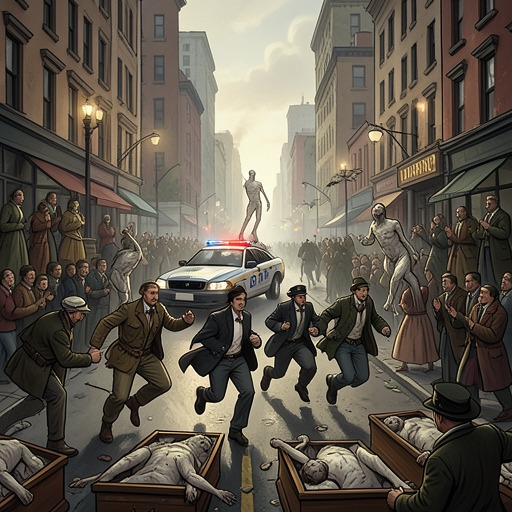
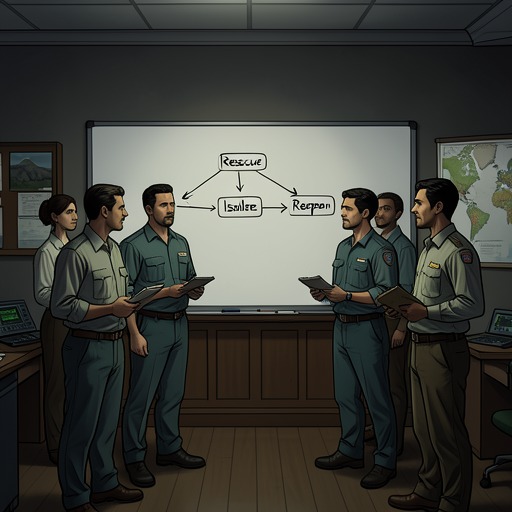
At 00.45, as public pressure mounted for a statement from the Dead Room, officials met briefly over the confusion surrounding terminology. They unanimously adopted “reliving” to refer to the awakened dead. The choice was made in the first hours of a rapidly expanding crisis: a reliable report put the number of cemetery awakenings at around 980, and the police said they lacked the resources to manage the exhumations.
The new word entered use while the response was being reorganized around transport and hospital capacity. At 01.00, Danderyd Hospital reported that 430 reliving had been admitted to its Clinic for Infectious Diseases, and that wards were being cleared to make room for more. With most ambulances assigned to transport, other hospitals were asked for assistance; available taxis were called in to carry patients from Danderyd. The label thus circulated in a setting where the returned were being handled both as an unprecedented category and as people requiring hospital care.
Public language and its limits
The policy did not immediately produce consistent language. At 01.05, the Dead Room received a statement attributed to Johan Stenberg, appointed head of the military emergency action, describing the bodies as a logistical problem. A press secretary agreed to explain the correct terminology to him. The episode exposes the distance between official naming and the assumptions embedded in the practical response: the term had been agreed upon, but even a senior official continued to speak of the returned as corpses.
That gap widened in international reporting. CNN became the first foreign television station to cover the events in Stockholm, showing the chaos outside Danderyd and referring to patients being moved to other hospitals as “the living dead.” The description revived the very uncertainty the Dead Room had tried to contain. Foreign-media calls then increased, and a spokesperson from the Foreign Ministry was assigned to handle them. The adopted term was therefore not merely a label for internal records; it was also a contested attempt to make the event intelligible in public without relying on the more sensational language used abroad.
Classification, medicine, and law
Calling the returned “reliving” did not settle what rights or status they possessed. A philosophical article on the crisis notes that existing law gives no straightforward protection to someone declared deceased, apart from the peace of the grave, and questions whether that protection applies in these circumstances. It anticipates that the law may soon change and argues that medical experts should use the interim period to conduct tests that could later become illegal. The article frames the dilemma in terms of possible suffering weighed against benefits to other people: it cites 65 deaths in Stockholm without awakenings over two days and approximately 300,000 deaths worldwide in the same period.
The uncertainty also appears in clinical practice. A toxicologist explains that a returned woman is being examined on the assumption that a foreign substance may have been introduced, using equipment unavailable elsewhere. The account places the examination alongside ordinary investigations of suspected murder, even as it distinguishes the case through the special equipment involved. Such scenes show the limits of terminology as a safeguard: naming the returned “reliving” gives them a distinct category, but does not by itself determine whether examinations, access, or treatment should follow the standards applied to living patients.
Significance
The policy is a small administrative act with consequences larger than its wording. It attempts to create a stable public vocabulary at the moment when familiar categories—corpse, patient, and legal person—no longer fit cleanly. Yet the emergency response repeatedly unsettles that vocabulary: the returned are transported as patients, described as corpses, and discussed under laws that still treat the declared dead as outside ordinary judicial boundaries. “Reliving” names the crisis without resolving it, making the gap between official classification and ethical or legal recognition visible.